

IOL Exchange Surgery

Medically reviewed by Keith Tokuhara, MD
Board-Certified Ophthalmologist | Medical Retina Fellowship-Trained
NPI 1386822641 | California Medical License A97863 | American Board of Ophthalmology Certification | Loma Linda University, Medical Retina Fellowship 2010.
Replacing a Lens Implant That No Longer Fits the Eye
IOL exchange focuses on removing an existing artificial lens and replacing it with another implant when the current lens is the source of symptoms or risk. It may be considered after cataract surgery when lens power, position, material, or tolerance is no longer appropriate for the patient’s eye.
At Desert Vision Surgery, Dr. Keith Tokuhara reviews the reason for the original implant problem and the condition of the whole eye before recommending a replacement plan.
What Is the IOL Exchange?
Replacing an Existing Lens Implant
IOL exchange is a surgical procedure that removes an existing intraocular lens implant and replaces it with a different lens. Unlike routine cataract surgery, it takes place in an eye that has already been operated on, where scar tissue, capsule changes, weak zonules, prior laser treatment, or reduced lens support may be present.
Before recommending surgery, Dr. Tokuhara evaluates the lens position, capsule support, cornea, retina, eye pressure, prior surgical history, and visual goals. This helps him determine the safest replacement plan, including whether the new lens can be placed normally or requires additional support through scleral or iris fixation.

When Is IOL Exchange Needed?
When Replacement Is the Better Option
IOL exchange may be considered when an existing lens implant causes persistent glare, halos, blurred vision, poor visual quality, or an incorrect refractive result. It may also be appropriate when the lens is damaged, poorly tolerated, or cannot be safely repositioned. A complete examination must confirm that the implant is causing the symptoms.
IOL exchange is most relevant when the implant itself is the problem, rather than a cornea, retina, or prescription issue. It may be considered when the current lens is the wrong type, poorly tolerated, damaged, or unable to provide stable visual quality.
Exchange may be discussed for patients with:
- Persistent glare, halos, or blur linked to the implant
- Incorrect lens power or unwanted refractive result
- Poor tolerance of a premium or multifocal lens
- Lens damage, opacity, or material concerns
- An implant that cannot be safely repositioned
Dr. Tokuhara confirms that the lens is truly driving the problem before recommending replacement.
Should an IOL Be Replaced or Repositioned?
Choosing the Right Way to Correct the Problem
IOL exchange replaces the existing implant, while lens repositioning keeps the current lens and moves or stabilizes it. A Light Adjustable Lens adjustment or laser touch-up may correct a remaining prescription without replacing the implant, but only when the lens is stable and otherwise functioning properly.
| Treatment Option | Capsular Bag Status | Typical Recovery | Ideal Candidate | General Risk Profile |
|---|---|---|---|---|
| IOL Exchange | May be considered when the capsule can support a new lens or when another fixation method can provide support | Requires surgical healing and follow-up as the new lens settles and inflammation improves | A patient whose existing lens has the wrong power or design, is damaged, is poorly tolerated, or cannot be safely stabilized | More invasive because the existing lens must be removed. Risks vary based on prior surgery, capsule support, vitreous involvement, and the fixation method required. |
| IOL Repositioning | Usually requires enough remaining capsule, zonular, scleral, or iris support to recenter and secure the existing lens | Requires surgical healing, although the existing implant remains in the eye | A patient whose current lens is optically appropriate but has shifted, rotated, tilted, or become unstable | Avoids replacing an otherwise suitable lens, but risks can include inflammation, pressure changes, retinal complications, or future movement. |
| Corneal Refractive Surgery (i.e. Lasik or PRK) | The capsular bag and implanted lens should be stable and properly positioned | Usually shorter than recovery from intraocular revision surgery, although several visits or treatments may be needed | A patient with a stable implant and residual nearsightedness, farsightedness, or astigmatism rather than a damaged or dislocated lens | Increased risk of worsening ocular surface disease and dry eye problems. |
Not every lens implant problem requires an exchange. In some cases, the existing IOL may still be the right lens but needs to be repositioned or secured so it remains centered and stable.
If the implant is stable and the main concern is a remaining prescription error, another procedure may be more appropriate. Other carefully selected patients may be candidates for a Corneal Refractive Surgery, such as LASIK or PRK.
An exchange may be more appropriate when the appropriate when the lens is dislocated, has the wrong power or design, causes persistent optical symptoms, is damaged, or cannot be safely repositioned. When the capsule cannot provide enough support, Dr. Tokuhara may consider Yamane sutureless scleral fixation, a scleral-sutured lens using Gore-Tex sutures, or iris-based fixation.
Dr. Tokuhara determines the safest approach based on the cause of the symptoms, the condition of the existing lens, the structure of the eye, and the likelihood of long-term stability.
How Is the Cause of Vision Problems Evaluated?
Understanding the Cause Before Choosing Surgery
Before IOL exchange, the evaluation is designed to confirm whether the existing implant is actually causing the patient’s symptoms. If blur or glare is coming from the ocular surface, retina, glaucoma, or residual prescription, changing the lens may not solve the problem.
The workup may review:
- Current IOL model, power, position, and centration
- Prior operative records and YAG laser history
- Corneal shape, dry eye, and astigmatism
- Retina and macular status
- Eye pressure and glaucoma risk
- Amount of capsule support for the new implant
- Whether vitreous has moved into the front of the eye
These findings help Dr. Tokuhara determine whether exchange is justified and how the replacement lens should be supported.
If vitreous has moved forward because of a damaged capsule, weak zonules, or previous surgery, either a limited vitrectomy or two staged surgery with pars plana vitrectomy may be needed. This procedure removes vitreous from the front of the eye before the lens is repositioned or replaced.
How Is a Replacement Lens Selected?
Matching the New Lens to the Eye’s Health and Visual Goals
Choosing a replacement lens requires careful attention to the patient’s anatomy, visual goals, and long-term eye health. In an IOL exchange case, planning is often more complex because the eye may have prior surgery, altered anatomy, retina or corneal concerns, glaucoma, trauma history, or limited capsule support.Some patients may benefit from a more advanced lens option, while others may need a simpler, more stable implant.
At Desert Vision Surgery, lens recommendations are individualized to support visual quality, lens stability, and the safest long-term outcome for the eye.

Can IOL Exchange Be Performed After Previous Eye Surgery?
Planning Around the Eye’s Surgical History
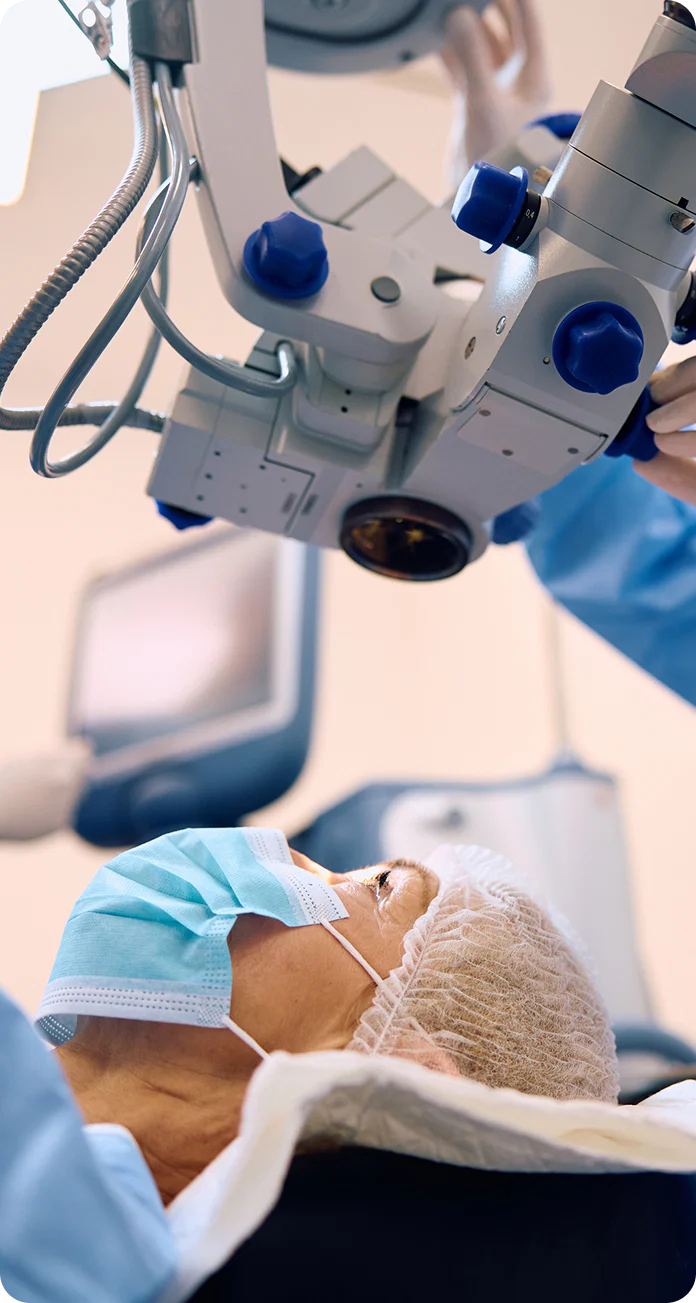
Many patients who need IOL exchange have already had cataract, retina, glaucoma, trauma, or laser procedures, which can affect anatomy, capsule support, zonule strength, pressure behavior, inflammation, and healing. Prior surgery does not automatically prevent IOL exchange, but it makes planning more important.
Dr. Tokuhara reviews the eye’s surgical history, current lens position, retina health, and available support before recommending treatment, helping create a safer plan for patients whose cases may be more complex than routine lens surgery or standard cataract care.
What Happens When the Eye Has Limited Lens Support?
A replacement lens normally rests within the capsule that once held the natural lens. When the capsule or its supporting fibers are weak, damaged, or absent, the new lens may need to be secured using another surgical method.
The appropriate technique depends on the health of the capsule, iris, cornea, retina, and other structures inside the eye.
Options may include:
- Yamane sutureless scleral fixation: The lens is secured to the wall of the eye without permanent sutures.
- Scleral-sutured IOL fixation: The lens is anchored to the wall of the eye with sutures, which may include Gore-Tex in selected cases.
- Iris fixation: The lens is secured to healthy iris tissue when the iris can provide adequate support.
- Iris-claw lens placement: A specially designed lens is attached to the iris in selected cases, though this technique is not currently used in the United States.
- Sulcus placement: When part of the original capsule remains, the lens may be placed in a supporting space behind the iris.
An anterior chamber lens, which is positioned in front of the iris, may also be considered in carefully selected patients.
No single method is right for every eye. Dr. Tokuhara selects the approach based on the available support, previous procedures, tissue health, and the need for stable lens placement.
What Is Recovery Like After IOL Exchange?
Setting Realistic Expectations for Healing and Vision
Choosing a replacement lens requires careful attention to the patient’s anatomy, visual goals, and long-term eye health. In an IOL exchange case, planning is often more complex because the eye may have prior surgery, altered anatomy, retina or corneal concerns, glaucoma, trauma history, or limited capsule support.
Some patients may benefit from a more advanced lens option, while others may need a simpler, more stable implant.

Why Choose Desert Vision Surgery for IOL Exchange?
Built for Advanced Lens Revision Care
Desert Vision Surgery is equipped for patients who need a careful decision about whether a lens should truly be replaced. IOL exchange requires more than choosing a new implant. It requires understanding why the first lens is not working and how the replacement can be positioned safely.
Patients choose Desert Vision Surgery for:
- Careful review of IOL power, design, position, and tolerance
- Planning for lens removal in previously operated eyes
- Replacement lens selection based on anatomy and visual goals
- Attention to the cornea, retina, eye pressure, iris, and capsule support
- Planning for Yamane, scleral-sutured, or iris-based fixation when needed
- Vitrectomy planning when vitreous has moved forward
- Experience with complex cataract and lens revision cases
- Retina-informed surgical judgment
- Patient education before lens replacement
- Ethical recommendations when exchange is not the best answer
The goal is to replace the lens only when it is the right step for the patient’s long-term vision and eye health.
For Referring Physicians
A Trusted Destination for IOL Exchange Referrals
Desert Vision Surgery welcomes referrals for patients who may need IOL exchange, lens repositioning, dislocated IOL repair, or secondary lens fixation. Appropriate cases may include unstable or decentered lenses, poor lens tolerance, incorrect lens power, weak capsule support, prior retinal surgery, trauma-related lens problems, or complex anterior segment anatomy.
Schedule an IOL Exchange Consultation
If you have had cataract surgery and are experiencing blurred vision, glare, halos, lens instability, or concerns about your lens implant, Desert Vision Surgery can help you understand your options.
A consultation can determine whether IOL exchange, lens repositioning, secondary lens fixation, or another treatment approach may be appropriate for your eye.
Frequently Asked Questions About IOL Exchange
What is IOL exchange?
Lens repositioning is a surgical procedure used to move an existing intraocular lens implant into a more stable or better-aligned position.
Can a cataract lens implant be replaced?
A lens implant may need repositioning if it has shifted, tilted, become decentered, or is causing visual symptoms because it is no longer sitting in the ideal position.
Is IOL exchange the same as cataract surgery?
No. Lens repositioning keeps the existing implant and improves its placement or support. IOL exchange removes the implant and replaces it with a different lens.
Why would someone need an IOL exchange?
Yes. A shifted or tilted lens implant may cause blurry vision, glare, distortion, double vision, or other visual symptoms, depending on its position and the health of the eye.
What is the difference between IOL exchange and lens repositioning?
In some cases, yes. Eyes with prior cataract, retina, glaucoma, trauma, or laser procedures may need more careful planning before lens repositioning.
Is IOL exchange right for everyone with unhappy vision after cataract surgery?
If the existing lens cannot be safely stabilized, Dr. Tokuhara may discuss other options, such as IOL exchange or secondary lens fixation.
Can IOL exchange be performed after retina surgery?
Recovery varies based on the eye’s health, prior surgery, and whether additional fixation was needed. Follow-up care is important to monitor healing, pressure, inflammation, and lens stability.
What should referring doctors send with an IOL exchange referral?
Recovery varies based on the eye’s health, prior surgery, and whether additional fixation was needed. Follow-up care is important to monitor healing, pressure, inflammation, and lens stability.
About Dr. Keith Tokuhara
Dr. Keith Tokuhara is a board-certified ophthalmologist practicing in Rancho Mirage, California. He completed a Medical Retina fellowship at Loma Linda University, 2010, and focuses his surgical work on complex lens repositioning cases, including tilted, decentered, unstable, and dislocated intraocular lenses that may require additional fixation. He is a member of the American Academy of Ophthalmology, ASCRS, American Society of Retina Specialists, and Desert Doctors.
- NPI 1386822641
- California Medical License A97863
- American Board of Ophthalmology, certified 2012
- Loma Linda University, Medical Retina Fellowship 2010

35900 Bob Hope Dr.,
Suite 155
Rancho Mirage, CA 92270
Fax: (760) 568-2490
Opening Fall 2026
Desert Vision Surgery is currently under development and will begin welcoming patients soon