

Cataract Surgery Case Gallery

Examples of Coordinated Cataract and Retina Care
The following case examples highlight scenarios in which patients with concurrent cataract and retinal pathology benefit from coordinated care between the retina specialist and Dr. Tokuhara, a cataract surgeon with fellowship training in medical retina.
These examples illustrate situations where combined expertise facilitates safer and more efficient surgical management, enhances visualization for posterior segment procedures, and supports improved overall patient outcomes. By collaborating closely, we can streamline care for complex cases that require both anterior and posterior segment considerations, strengthening our partnership within the community to achieve the best possible visual results for our shared patients.
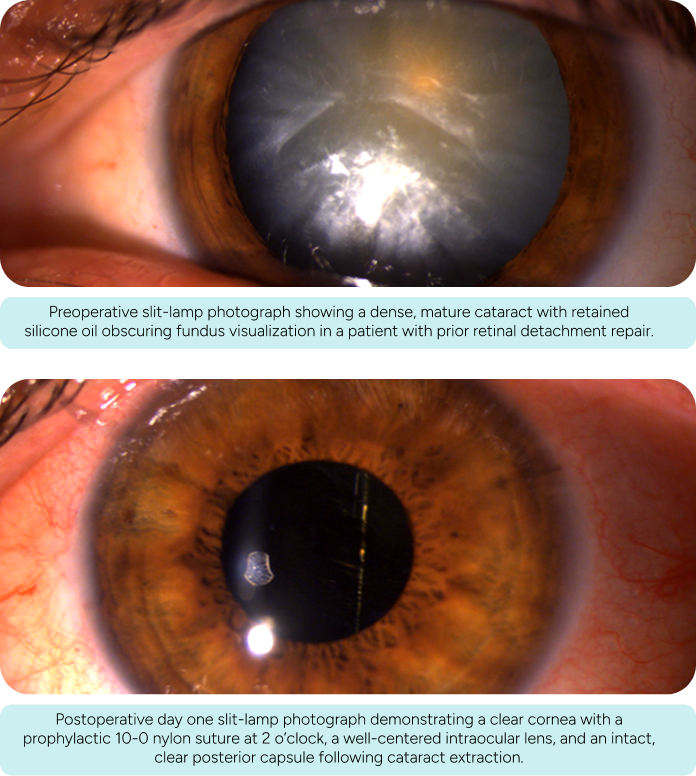
Retinal Detachment with Silicone Oil and Visually Significant Cataract
A 38-year-old patient with a history of retinal detachment underwent pars plana vitrectomy with silicone oil tamponade. Upon return for silicone oil removal, the retina surgeon noted a recurrent inferior detachment; however, visualization was severely limited by a dense cataract. Silicone oil was replaced, and the patient was referred to Dr. Tokuhara for cataract extraction to restore intraoperative visibility.
A prophylactic 10-0 nylon was placed at the clear corneal incision in preparation for the upcoming retina surgery. Two weeks later, the retina surgeon successfully performed silicone oil removal and a membrane peel, facilitated by the clear optical media following cataract surgery.
Choroidal Melanoma Requiring Urgent Cataract Removal Prior to Brachytherapy
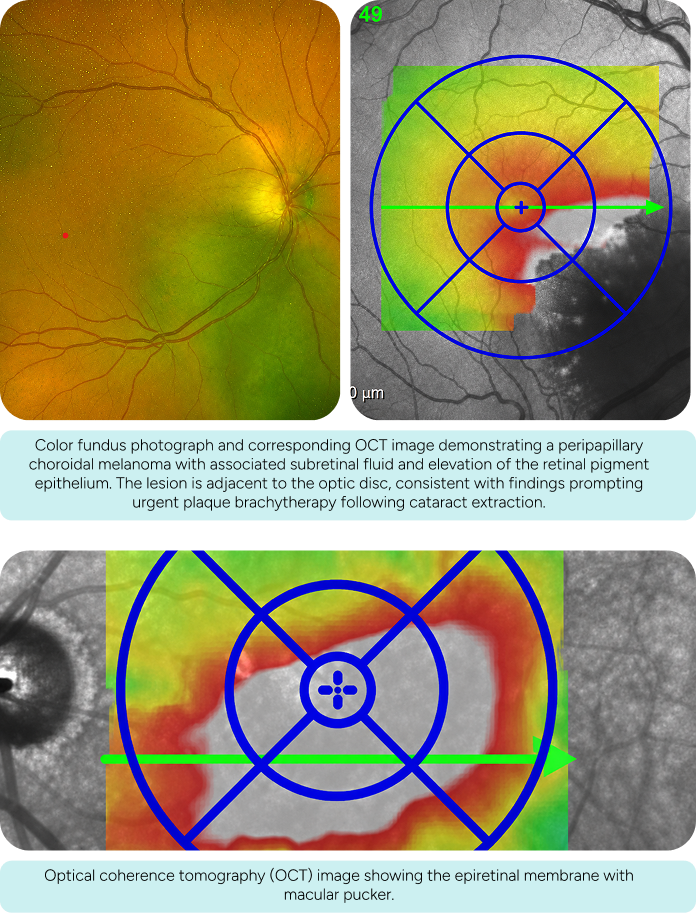
A 77-year-old patient diagnosed with choroidal melanoma was referred to Dr. Tokuhara for urgent cataract extraction to optimize visualization before planned pars plana vitrectomy and plaque brachytherapy.
Dr. Tokuhara’s experience with both anterior and posterior segment pathology allowed for a safe and efficient cataract removal, minimizing surgical trauma and ensuring a clear view for the subsequent oncologic and retinal procedures.
Epiretinal Membrane with Visually Significant Cataract
A 79-year-old patient with an epiretinal membrane presented with reduced visual acuity due to concurrent cataract. The retinal surgeon requested cataract extraction prior to a planned membrane peel and macular hole repair.
Dr. Tokuhara performed cataract surgery with attention to minimizing vitreous traction and optimizing postoperative visualization for macular surgery. The improved fundus view subsequently allowed for a safer and more precise vitrectomy.
Late In-the-Bag IOL Dislocation
A 73-year-old patient with a history of 8-cut radial keratotomy and cataract surgery presented on 3/4/25 with sudden vision loss in the left eye while walking her dog. Visual acuity declined from 20/50 to 20/400. Examination revealed an intraocular lens dislocation in the left eye, with the haptic rotated to the 10 o’clock position and displaced inferiorly.
A modified double-flanged scleral fixation technique was performed to re-fixate the lens implant. At her postoperative visit the following day, her uncorrected vision had improved to 20/40, and the IOL was well-centered with all four flanges securely covered and stable.

Secondary IOL Placement After Posterior Dislocation and IOL Explantation
A 76-year-old patient developed late-onset posterior dislocation of the IOL and underwent pars plana vitrectomy with lens removal by a retinal surgeon. The patient was subsequently referred to Dr. Tokuhara for secondary IOL implantation using the Yamane intrascleral fixation technique.
His dual skill set in both anterior segment surgery and additional training in medical retina enabled precise lens fixation, controlled intraocular handling, and reduced the risk of retinal injury or postoperative inflammation.

35900 Bob Hope Dr.,
Suite 155
Rancho Mirage, CA 92270
Fax: (760) 568-2490
Opening Fall 2026
Desert Vision Surgery is currently under development and will begin welcoming patients soon