

Lens Repositioning

Medically reviewed by Keith Tokuhara, MD
Board-Certified Ophthalmologist | Medical Retina Fellowship-Trained
NPI 1386822641 | California Medical License A97863 | American Board of Ophthalmology Certification | Loma Linda University, Medical Retina Fellowship 2010.
Realigning a Lens Implant That May Still Be Usable
Lens repositioning is different from lens replacement. The existing IOL may still be the right lens, but it has shifted, tilted, or become less secure. Repositioning focuses on improving how that lens sits inside the eye so it can function more reliably.
At Desert Vision Surgery, Dr. Keith Tokuhara evaluates whether the current implant can be safely preserved and stabilized rather than removed.
What Is Lens Repositioning?
Stabilizing an Existing Lens Implant
Lens repositioning moves an existing intraocular lens into a more stable and centered position. It may be appropriate when the lens power and design are still suitable, but the implant has shifted, tilted, or become unstable after cataract surgery.
The procedure preserves the existing implant rather than replacing it. Dr. Tokuhara evaluates how the lens is positioned, how much support remains inside the eye, and whether stabilization can improve vision without requiring an IOL exchange.
The goal is to restore better alignment and long-term stability while protecting the cornea, iris, retina, and other surrounding structures.

When Is Lens Repositioning Needed?
Not Every Lens Problem Requires an Exchange
Lens repositioning may be considered when the current implant is still useful but no longer sitting where it should. The focus is on preserving the lens while improving centration, tilt, or stability.
This may apply when the lens power and design remain appropriate, but vision is affected by subtle movement, decentration, or support weakness. Dr. Tokuhara evaluates whether stabilization can address the problem without the added steps of removing and replacing the lens.
Should an IOL Be Repositioned or Replaced?
Choosing the Right Corrective Approach
Lens repositioning preserves the current implant, while IOL exchange removes it and replaces it with a different lens. The best option depends on the condition and power of the lens, the amount of remaining support, the patient’s symptoms, and the likelihood of long-term stability.
| Treatment Option | Capsular Support Needed | Primary Indication | Surgical Technique | Typical Recovery |
|---|---|---|---|---|
| Lens repositioning | Enough remaining capsule, zonular, iris, or scleral support to secure the existing implant | The current lens has shifted, tilted, rotated, or become unstable but remains suitable in power, design, and condition | The surgeon recenters the existing lens and may secure it to the remaining capsule, iris, or sclera | Recovery varies based on the amount of repositioning and whether added fixation is required. Follow-up focuses on lens stability, inflammation, eye pressure, and vision. |
| IOL Exchange | The eye must be able to support a replacement lens through the capsule or another fixation method | The existing lens has the wrong power or design, is damaged, is poorly tolerated, or cannot be safely stabilized | The surgeon removes the current implant and places a new IOL in the capsular bag, sulcus, or with scleral or iris fixation | Recovery may take longer than repositioning because the existing lens is removed and replaced. Healing depends on prior surgery, capsule support, vitreous involvement, and the method used to secure the new lens. |
| Corneal Refractive Surgery | The capsular bag and existing IOL should be stable and properly positioned | The implant is functioning well, but nearsightedness, farsightedness, or astigmatism remains after cataract surgery | A corneal laser procedure, such as LASIK or PRK, reshapes the cornea without moving or replacing the implanted lens | It does not always correct all refractive error and increases risks of ocular surface disease and dry eye symptoms. |
Lens repositioning and IOL exchange are both part of advanced IOL revision care, but they are not the same procedure. Repositioning keeps the existing lens and focuses on improving its placement or support. IOL exchange removes the existing implant and replaces it with a different lens.
The right choice depends on the lens condition, lens power, capsule support, eye anatomy, and the patient’s symptoms. Dr. Tokuhara determines which option offers the safest path for long-term stability and visual improvement.
Why Can a Lens Implant Shift After Cataract Surgery?
Understanding the Cause of Instability
A lens implant may shift when the natural support structures inside the eye become weak, damaged, or changed over time. Understanding the cause helps Dr. Tokuhara decide whether the lens can be repositioned or whether additional support may be needed.
Common causes may include:
- Prior eye surgery
- Eye trauma
- Pseudoexfoliation
- Capsule weakness
- Zonular weakness
- Inflammation
- Long-term changes after cataract surgery
Some eyes have enough remaining support for repositioning, while others may require additional fixation to restore a more secure lens position.

How Is a Shifted or Unstable Lens Evaluated?
Looking at the Whole Eye, Not Just the Lens
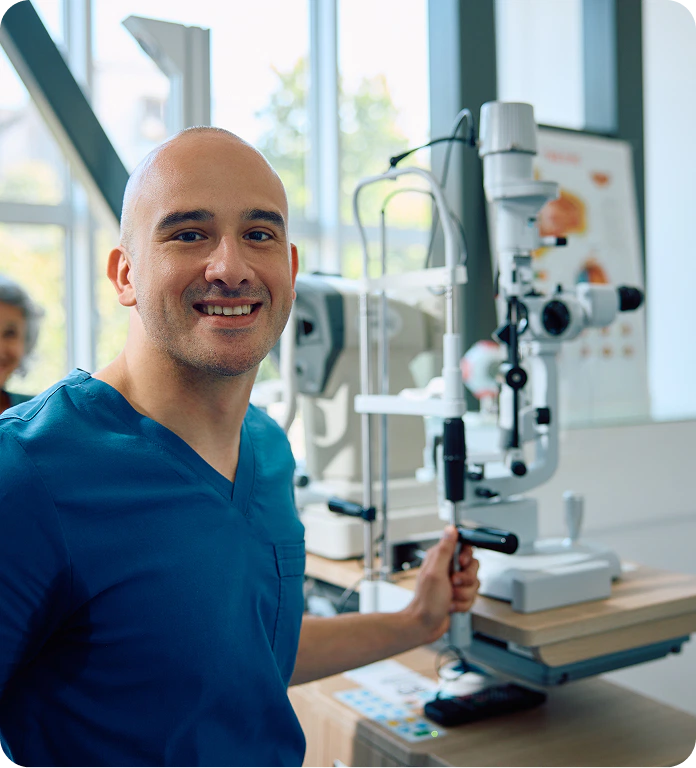
Before recommending repositioning, Dr. Tokuhara studies how the lens sits inside the eye and whether small changes in tilt, decentration, or instability match the patient’s symptoms. The evaluation also considers capsule and zonule strength, corneal clarity, retina health, pressure behavior, and prior operative history. The key question is whether the existing lens can be safely preserved. If the implant is damaged, poorly powered, or not suitable for the eye, another procedure may be a better choice.
How Is an Unstable Lens Secured in Place?
Supporting the Lens When Natural Support Is Weak
When the capsule or the small supporting fibers around it can no longer hold an intraocular lens securely, Dr. Tokuhara may reposition the implant and use an additional fixation method. The approach depends on how much natural support remains and the condition of the iris, sclera, cornea, retina, and vitreous.
Potential techniques may include:
- Sulcus placement with optic capture: When the rim of the anterior capsule remains intact, the lens may be placed in the ciliary sulcus, a supporting space behind the iris. The central optic is then positioned through the capsular opening to improve centration and stability.
- Yamane sutureless flanged fixation: When capsular support is inadequate, the haptics, or supporting arms, of a three-piece lens are passed through the sclera using a double-needle technique. Small flanges are formed at the haptic tips to hold the lens in place without permanent sutures.
- Scleral-sutured IOL fixation: The lens may be anchored to the sclera, the white wall of the eye, using Gore-Tex or polypropylene sutures. This can stabilize an existing lens or support another suitable implant when the capsule cannot hold it securely.
- Iris-sutured fixation: When the iris is healthy enough to provide support, the lens may be centered and secured to the iris using techniques such as McCannel sutures or a Siepser slipknot. These approaches allow the surgeon to tie the supporting sutures through small incisions.
- Vitrectomy: If vitreous gel has moved forward because of capsule damage, zonular weakness, lens movement, or previous surgery, it may need to be removed from the front of the eye before the lens is secured. This helps clear vitreous from the surgical area and reduce unwanted traction on structures toward the back of the eye.
Not every technique is appropriate for every patient. Dr. Tokuhara evaluates the existing lens, remaining capsular support, prior procedures, and overall eye health before determining whether the implant can be preserved and how it should be stabilized.
Can Lens Repositioning Be Performed After Previous Eye Surgery?
Planning Around Prior Surgery and Eye History
Many patients who need lens repositioning have already had cataract surgery, retinal surgery, glaucoma treatment, trauma repair, or laser procedures. These prior treatments can affect lens support, inflammation, pressure behavior, and healing. Previous surgery does not automatically prevent lens repositioning, but it does make planning more important.
Dr. Tokuhara’s experience with complex cataract and anterior segment cases helps guide care for patients whose lens concerns may be more advanced than routine cataract surgery.


What Is Recovery Like After Lens Repositioning?
Setting Realistic Expectations for Healing
Recovery after lens repositioning is often focused on lens stability rather than adapting to a new implant. Patients may notice improvement as the lens settles into a better position, but healing can vary if fixation was needed or if the eye has prior surgery, glaucoma, retina disease, or inflammation. Follow-up visits allow Dr. Tokuhara to confirm that the lens remains centered and that pressure, inflammation, and vision are moving in the right direction.
Why Choose Desert Vision Surgery for Lens Repositioning?
Built for Advanced IOL Revision Care
Desert Vision Surgery is built for patients who may not need a new implant, but do need a more precise plan for stabilizing the one they already have. Lens repositioning requires judgment about when preserving the current lens is safer than exchanging it.
Patients choose Desert Vision Surgery for:
- Evaluation of lens tilt, centration, and movement
- Focus on preserving a usable implant when appropriate
- Planning for added support if the lens is unstable
- Experience with post-cataract lens complications
- Careful decision-making for previously operated eyes
- Recommendations based on anatomy, not a standard template
The goal is to improve lens position while avoiding unnecessary replacement when the existing lens can still serve the eye well.
For Referring Physicians
A Trusted Destination for Lens Repositioning Referrals
Desert Vision Surgery welcomes referrals for patients with decentered, tilted, subluxated, or unstable lens implants. Appropriate cases may include patients with visual distortion, glare, poor lens position, weak capsule support, trauma history, prior retinal surgery, or complex anterior segment anatomy requiring advanced IOL revision evaluation.
Schedule a Lens Repositioning Consultation
If you have had cataract surgery and are experiencing blurred vision, glare, distortion, or concerns about a shifted lens implant, Desert Vision Surgery can help you understand your options. A consultation can determine whether lens repositioning, IOL exchange, secondary fixation, or another treatment approach may be appropriate.
Frequently Asked Questions About Lens Repositioning
What is lens repositioning?
Lens repositioning is a surgical procedure used to move an existing intraocular lens implant into a more stable or better-aligned position.
Why would a lens implant need to be repositioned?
A lens implant may need repositioning if it has shifted, tilted, become decentered, or is causing visual symptoms because it is no longer sitting in the ideal position.
Is lens repositioning the same as IOL exchange?
No. Lens repositioning keeps the existing implant and improves its placement or support. IOL exchange removes the implant and replaces it with a different lens.
Can a shifted lens implant cause blurry vision?
Yes. A shifted or tilted lens implant may cause blurry vision, glare, distortion, double vision, or other visual symptoms, depending on its position and the health of the eye.
Can lens repositioning be done after prior eye surgery?
In some cases, yes. Eyes with prior cataract, retina, glaucoma, trauma, or laser procedures may need more careful planning before lens repositioning.
What if the lens cannot be safely repositioned?
If the existing lens cannot be safely stabilized, Dr. Tokuhara may discuss other options, such as IOL exchange or secondary lens fixation.
How long does recovery take after lens repositioning?
Recovery varies based on the eye’s health, prior surgery, and whether additional fixation was needed. Follow-up care is important to monitor healing, pressure, inflammation, and lens stability.
About Dr. Keith Tokuhara
Dr. Keith Tokuhara is a board-certified ophthalmologist practicing in Rancho Mirage, California. He completed a Medical Retina fellowship at Loma Linda University, 2010, and focuses his surgical work on complex lens repositioning cases, including tilted, decentered, unstable, and dislocated intraocular lenses that may require additional fixation. He is a member of the American Academy of Ophthalmology, ASCRS, American Society of Retina Specialists, and Desert Doctors.
- NPI 1386822641
- California Medical License A97863
- American Board of Ophthalmology, certified 2012
- Loma Linda University, Medical Retina Fellowship 2010

35900 Bob Hope Dr.,
Suite 155
Rancho Mirage, CA 92270
Fax: (760) 568-2490
Opening Fall 2026
Desert Vision Surgery is currently under development and will begin welcoming patients soon